Author Archives: wadennis42

Bottom Round Pot Roast with Onion Gravy

I found this recipe in my “keeper” folder but, of course, could not remember much about it…except that both Steve and I must have enjoyed it, hence its place in the “keeper” folder.  Memory like a screen these days…  ANYWAY… I tried it again and am making sure to record things this time.  🙂

Here the recipe from Allrecipes.com, one of my favorite recipe sites, from which I worked: Bottom Round Roast with Onion Gravy

And, here is my take.  First of note is that this is a stove-top dish, although I am sure it would do fine in a 190 or 200 degree oven or in a slow cooker.  If I try it that way, I’ll make note of it here.  But, the nice thing about this recipe is that it CAN be make on a burner.  In fact, when I was about to make this recipe, my oven suddenly defaulted into Sabbath mode and only the burners were working…Thankfully I was able to reset things, but the good news is that I could still have made this dish if the the oven had remained out of order!

But, I digress.  So, here is my take on this dish:

  • 3 or so cups of sliced onions.  (see picture for amount)
  • 2 or 3 cloves of garlic, minced
  • bottom round roast (I used one almost 3 pounds)
  • salt, pepper, dried rosemary to season roast before browning
  • a sprig or two each fresh rosemary and thyme
  • 1/2 cup Merlot
  • 1 bay leaf
  • 1 tablespoon vinegar (I used cider)

After cooking the roast

  • another 1/2 cup Merlot
  • 3/4 cup beef broth
  • 1/2 teaspoon each dried thyme and rosemary
  • 1 cup chopped fresh mushrooms
  • 1 tablespoon flour, if needed to thicken

First, I sliced up the onion and minced the garlic.

onions

I used two BIG onions, but in general, one onion makes about a cup, chopped or sliced.

The original recipe was intended as a very easy prep dish, and the reviews indicate that it all tasted great without browning the meat first. But, I wanted to add some extra flavor, so I started off by browning the roast in my dutch oven after seasoning with freshly ground pepper, kosher salt, and crumbled dried rosemary.

I then removed the roast and put the onions, garlic, fresh rosemary and thyme, and Merlot in the pan, turned up the heat, and deglazed the pan, scraping up the brown bits.

deglazing

deglazing with the Merlot and herbs

Next, keeping things simmering, I added the bay leaf,  and sprinkled in the vinegar before placing the browned roast, with the layer of fat up, on the onions.

ready to cook

Ready to cover and cook!

I then covered and cooked for three or so hours.  I used a heat diffuser to make sure nothing burned, but it probably would have been fine without one. But do make sure you use a heavy pot! I kept the burner on low and made sure that I heard just a little bit of sound when I put my ear really close so I knew it was at a low simmer, but didn’t let it stay hot enough to cause substantial steam to be released from under the cover. Basically, you want the temperature to stay under a boil, and preferably around or under 200 degrees. AND, don’t lift the cover until you think the roast is done!

cooked!

And here it is when first uncovered.

My next step was to remove the roast and tent with foil on the cutting board while I finished the gravy, starting by adding the other 1/2 cup of Merlot and simmering until the liquid was reduced by about half.

reduced onions

Look at those onions! Just gorgeous.

I then added the 3/4 cup beef stock (I actually used veal stock, but that is another story!) and the 1/2 teaspoon each of dried thyme and rosemary, and cooked it down a bit further.

with the Merlot

I took this shot because I wanted to emphasize that a good wine is preferable to a red “cooking” wine, and a nice Merlot is the best choice for enhancing the flavor of the dish, as well as the enjoyment of the cooking process. 🙂  Also, I’d like to note that the wine glass in the picture is the last of the set of four that my best friend Linda gave me years ago. ❤

Next, I added the mushrooms.

adding the mushrooms

Adding the mushrooms to the further reduced gravy.

To be honest, I don’t remember if I added any flour to thicken.  Based on my handwritten notes, I don’t think I did.  But, it is always an option if you want to thicken the gravy.

gravy done!

Thick enough!

The final steps: carve the meat, add to the gravy, and plate!

This was a really great recipe.  And truly, using a good red wine was key to it being exceptional.  To end this post, I served the beef with roasted potatoes (chop as shown, sprinkle with seasonings of choice (include rosemary for this menu) and olive oil, and roast at 425 for 45 or so minutes or until done) and steamed broccoli and carrots, as shown. Just lovely.

So easy, and leftovers are even better!  Enjoy!

Apple Ginger Pork Chops

It was early on a Sunday afternoon and I was hungry, with no patience to wait for an evening meal.  And, with the weather not cooperating for Steve for anything sailing, I decided to do an abbreviated version of a Sunday Dinner – less complicated, but to be served by mid-afternoon.

I had two pork chops on hand that needed using soon,  a gorgeous hunk of fresh ginger, and a Granny Smith apple; a quick Google search using these ingredients as keywords brought me to the following recipe:

Apple Ginger Pork Chops, by The Food Network’s Guy Fieri

I ended up making some adjustments, but other changing the amounts of some ingredients, I stuck to the recipe, but using the following proportions:

2 pork chops, 1 1/4-1 1/2 inch thick, center cut, bone in
1/4 cup apple cider vinegar
2 tablespoons extra-virgin olive oil, divided
3 teaspoons minced ginger
3 teaspoon minced garlic
2 tablespoons fresh lemon juice
1/2 teaspoon salt
1/2teaspoon pepper
1/4 cup white wine (cooking wine is fine)
1 cup sliced (1/4-inch) yellow onions (one medium onion)
2 cups cored and sliced (1/4-inch) Granny Smith  (one largish apple)
1/3 cup raisins
2 tablespoons butter

First, I mixed together the apple cider vinegar, 1 tablespoon extra-virgin olive oil, ginger, garlic, lemon juice, salt and pepper and marinated the chops for 60 minutes, flipping at 30 minutes.

The original recipe called for a 30 minute marinade in a Ziploc-type bag, but I used a corning ware casserole pan into which the two chops just fit.  On advice in a recipe review, I lengthened the marinade time, but I suspect it would benefit from an even longer marinade time if you are not in a hurry.  However, I agree with the reviewer’s warning to not marinade for too many hours since the acid in the vinegar and lemon juice can cause the meat to become mushy.

Once you are ready to cook the chops, preheat the oven to 350 degrees F. and, in a large saute pan, heat 1 tablespoon extra-virgin olive oil to almost smoking, then add pork chops, shaking off excess marinade. Brown on both sides.

browned chops

Next, place the chops on a sheet pan and put in the oven, uncovered, for 20 minutes or until internal temperature reaches 135 degrees F. (Check at 15 minutes)

In the same saute pan deglaze with the wine…

deglazed pan

… then add onions, apples and raisins and cook until apples are soft and onions are translucent.

add produce to pan

Just after adding to the pan.

part way done

After 5-7 minutes uncovered.

The original recipe did not specify whether or not to cover the pan.  I was not confident that the onions and apples would cook down enough without burning since there was not much liquid in the pan, so I covered the pan after 5-7 minutes and lowered the temperature from medium high to medium low. Next time, I will probably just cover from the beginning and then, if there is excess liquid, cook it off at the end.

reduced

After another 6-8 or so minutes, covered - and after the butter was added.

The last step: Add butter and salt and pepper, to taste, and keep warm while waiting for chops to be done.

Once the chops are to temperature, remove from oven and put the chops onto to the apple mixture and pour any juices into the mix, as well. Hold covered, on low warm, until ready to serve.

To accompany, I opted for potatoes, since I had some on hand, although rice would also work well.  As to veggies, I had a bell pepper that needed using and I wanted to keep things simple, so I tossed together 6 or so small red potatoes, quartered, a green bell pepper in large chunks/slices, and a small onion, quartered, with kosher salt, freshly ground pepper, and a small amount of a ginger/citrus shake I had in the cupboard thanks to a gift from my niece and baker/cook extraordinaire Meggie Dennis, finishing with a liberal amount of olive oil.  I have a counter-top toaster oven with a convection option, so I convect-roasted the potato mix, covered with foil, for around 35 minutes at 375 and finished off for about 5 minutes at 425 uncovered.  But if you have just one oven, preheat to 350 to start roasting the potato mix, covered, for 35 or so minutes before also putting the the pork chops in for their 20 minutes, and then raise the temperature to 425 to finish them off, uncovered, after the chops are done, as needed.

finshed meal

Dinner!

And, there you have it.  It got a “keeper” vote from both Steve and me. And, I especially like the technique of marinating, browning, baking, and creating a pan topping or sauce since it lends itself to unlimited variations in flavors. Roasted veggies of any sort also lend themselves to all sorts of menus and flavors. A keeper indeed.

Homemade Egg Rolls – Baked not Fried, and it works!

Disclaimer – forgive any typos, etc.  Posted after a long day!  🙂

When food shopping a few weeks ago, I picked up some egg roll wraps, just for fun.  A few weeks later, I realized that I needed to use them soon, as their freshness date (as a refrigerated product) was fast approaching.  I just happened to have a half a head of cabbage that needed to be used up, too, and I always carrots in the fridge and cooked chicken in the freezer.  No worries that the recipe from which I decided to start (the one on  the Nasoya wrap package) called for lean ground pork.  While starting with raw meat versus cooked adds yet another level of complexity to any dish, I had also found egg roll recipes that called for cooked chicken, so I decided to create my own recipe based on a few that I found online.

Here are the links to the two recipes from which I was working:

Nasoya Egg Roll Recipe
Baked Egg Rolls

Here is what I used:

  • 1-2 tablespoons oil for sauteing (I used peanut but canola is fine)
  • 1 teaspoon minced fresh ginger
  • 1 teaspoon minced fresh garlic
  • 2 cups finely chopped cabbage
  • 1/2 cup grated carrot
  • 1/3 cup small-diced daikon radish
  • 1/8 cup chopped chives
  • 2 cups finely diced cooked chicken
  • 2 Tablespoons hoisin sauce
  • 1/4 teaspoon anchovy paste
  • 1/4 teaspoon hot sauce
  • 1/2 teaspoon rice vinegar
  • 1 Tablespoon cornstarch
  • 1 Tablespoon + water to add to cornstarch
  • 1 Tablespoon additional water
  • 2 Tablespoons tamari (soy) sauce
  • 12 egg roll wraps

Okay – let me start by saying that you should feel free to look at other recipes for seasoning ideas!  I was playing around and what I used tasted yummy, but not all the same ingredients are necessary for excellent results.

For example, one recipe called for oyster sauce and I didn’t have any, but I had hoisin sauce.  After reading various opinions as to what was a suitable substitute for what, I figured I would add a bit of anchovy paste to add some depth without being overly “fishy.”  (Anchovy paste has a way more subtle effect than you would think.) And, I had no bean sprouts but I figured that the daikon radish I had on hand would add an extra texture, albeit not quite that of the sprouts but in step with an oriental dish. And, both recipes called for green onions, another ingredient I lacked.  But, I have some chives growing in a pot, so I tossed some of them in.

You may also notice that of the two recipes I cite as sources, one calls for minced ginger and one for minced garlic.  Well, hey, why not both?  Fun fact: Pearl, my cat of 18 years, whom I adopted when I was in my mid 20s, loved anything, including broccoli, if it was sauteed in garlic and ginger.  That cat had good taste. 🙂

Anywhoooo…the process was quick and easy.  First, I chopped the veggies.

chopped veggies

Then I sauteed the garlic and ginger:

garlic and ginger sauteeing

Then I added the veggies and cooked for just a few minutes until a bit soft but still with some crunch.

veggies cooking

Next, I added the chopped chicken and heated until warmed through, then added the sauce and cornstarch mix – everything from the hoisin sauce on in the ingredient list that I had mix together until smooth before adding.

Once the sauce was added to the chicken and heated through, I moved the mixture from the pan to a bowl so it could cool off enough to handle.  Then I started assembling the egg rolls.  I used 1/4 cup of filling for each wrap.

filling on wrap Just so you know, I had no idea that for the first 5-6 egg rolls, I didn’t realize how thin the wraps were and used two per roll.  Those that had a double wrap were fine, but not additionally good enough for me to recommend using double wraps all the time unless you try it and find you prefer a thicker egg roll wrap. 🙂

Then I folded up from the bottom and then from the side.

folded

Next, I used just a bit of water when finishing and securing the fold, put them on a very lightly greased cookie tray, brushed just a bit of olive oil on the tops, and put them in my convection/toaster oven at 425 for 12 minutes.

Both recipes noted above said between 10-15 minutes at 400 or 425 degrees in a regular oven, so I would pick your temperature and keep and eye on them.

final product

I thought these tasted great as is, but I did make a dipping sauce from soy sauce, a bit of rice wine vinegar, some sugar and a bit or minced garlic and onion.

So, the verdict is – homemade egg rolls are easy to make and, while there are plenty of recipes with instructions for frying, I think baking works just as well and even better for crispness, especially when reheating (10 minutes at 350 works) and, obviously makes for a lower fat content.

Next time I will make a bunch and freeze to bake at a later date.  Quick easy, and healthy – works for me!

Pork, Sweet Potato, and Cabbage Casserole on Soba Noodles

I have not posted for ages, but I was determined to document this concoction since it is  an experiment that worked.  🙂   Yes, I did start with a recipe, but I  adapted it so as to use up a few leftovers from my New Year’s Day open house, as well as some pork that was in the freezer,  some stray sweet potatoes, and a shallot.  In addition, as noted toward the end, it can also be easily adapted to fit a vegetarian diet.

Here is what I had: a pork sirloin mini roast (1.17 lbs) that I sliced an inch or a bit under thick, apple chutney that I had made but forgotten to put out on New Year’s Day, chopped cabbage that I had forgotten to add to the sweet and sour beef soup I made for and served on New Year’s Day, and two sweet potatoes and a shallot that I had on hand.

ingredients

The major ingredients

Here is the link to original recipe from which I was working:
Pork Chop Casserole Recipe with Sweet Potatoes

Obviously, I was not using chops, and this recipe calls for more than 1 lb or so of meat; also, it does not specify boned or bone-in. Given I had a smaller amount of meat, it worked out fine that I had only two small sweet potatoes, and I used about two cups of Apple Chutney (Click HERE for the recipe – it is buried in the pulled pork recipe but it is worth deciphering it out, so to speak) to replace the OJ, brown sugar, and spices.

I also did everything in an ovenproof skillet.  Note to self: Do Not forget to use a pot holder when taking the skillet out of the oven…)

Anyway, I started by lightly browning the pork in a bit of olive oil to help seal in moisture in the pork and to give a nice flavor base for the rest of the ingredients.

In the middle of browning the pork

After removing the pork and setting it aside, I added a bit more olive oil and lightly sauteed thinly sliced shallot and a few stems of fresh thyme until the shallot was soft and the thyme quite fragrant.

getting stated with the shallot and fresh thyme

I then removed the shallot and thyme, added yet a bit more olive oil, and put the onion (one medium, sliced) in the pan.

Next, the onions

Once the onion was starting to get soft, I added about 3 cups of chopped savoy cabbage. (I am sure any type of cabbage would do – in fact, the red kind would make for a REALLY colorful dish!)

Then, add the cabbage to the onions

Once the cabbage cooked down a bit (after maybe 5 minutes or so), I stirred in the sliced sweet potato and the pork, including the juices, and then arranged the shallot and thyme on top. Finally, I put the lid on the pan, and into the oven preheated to 350 degrees it went.

Ready for the oven!

sensual close-up shot 🙂

After 50 minutes, the potatoes were just tender and the meat was still moist, so I put the pan with the cover on it back in the oven on the “keep warm” setting (170 dgrees) since we were not quite ready to eat. If I had wanted to serve sooner, I probably would have put it back in at the 350 degrees for another 5-10 minutes.

Finished!

If I had had more sweet potatoes on hand, or a few white potatoes to add to the mix, this could very well have been a one-dish meal.  Or, I could have added some extra liquid and rice, or cooked rice separately and serve the pork and veggies over it. But, since it was a cold and stormy night, I thought soba noodles, made from the hearty buckwheat (often cited as good food for cold weather) would be the perfect match.  And, it was!

on a bed of soba noodles

This turned out to be quite tasty.  Upon reading the reviews of the original recipe, I think that it would fine as written, but both the original and my version would benefit from the sauce being thickened a bit, perhaps with cornstarch, and, in my version, I think a little more sweetness to counter the tart chutney would be nice.  But overall, I think the dish works well as written, as adapted by me, and as a base for further adaptations.  One note about the soba noodles:  They do not expand as much as regular pasta, so you may not have as much leftover as you would have thought.

leftovers!

If you don’t care to eat meat, this recipe can easily be adapted to suit a vegetarian diet.  If you want a concentrated protein source to serve as does the pork, then I  think tempeh would work wonderfully with this recipe. Tofu and seitan may work, also, albeit the textures of tofu and the usual tamari-based flavor of seitan would give a  different slant. This recipe could also inspire the creation of a rice, sweet potato, and cabbage (or other vegetable) casserole. Or, add edamame to replace the pork and still serve over the soba.

So, that’s it for now.  I really need to get back to blogging here on a more regular basis.  I have drafts and photos of various dishes and meals that I hope to document on this blog one of these days, but one the one ingredient I seem to always be low on is time, something for which thyme is no substitute…  <grin>

Husk Cherries – Try them, I bet you’ll like them!

If you see these at Farmer Dave’s next week at the Wakefield Farmers Market, buy some!

husk cherries in container

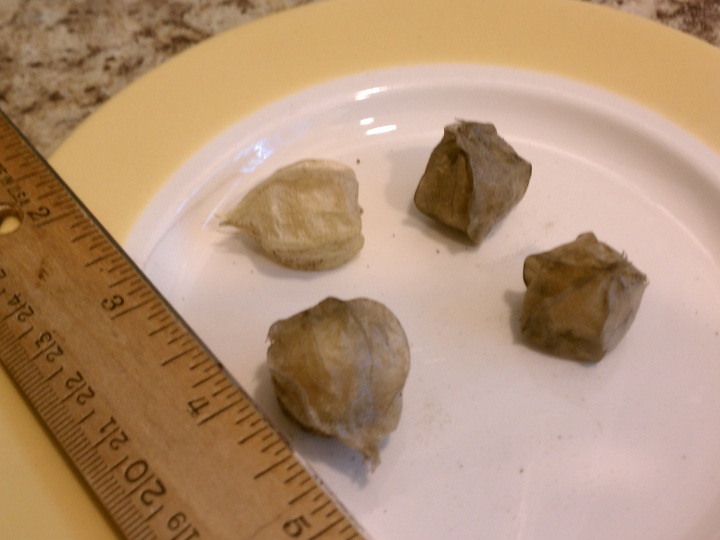
Husk cherries as packaged by Farmer Dave. This container is missing some. 🙂

I thought they were tiny tomatillos at first, but upon looking even more confused when told they were husk cherries, I was given one to try.  They are exquisite!  Actually, I am not even going to bother trying to describe them because, when searching the Internet to learn more about this tasty little fruit, I found a wonderful description – ode, almost – to the husk cherry on a blog.  Click the quoted text to go to the original blog post.

“Husk cherries stole my heart this summer. They rustle in your hand, weighing nothing and smelling of dust. It seems impossible that inside each paper lantern can hide one single golden berry. They’re the humble Cinderella of the farmer’s market, for sure.”

husk cherries on a plate

Here is another shot, this with a ruler to show size.

I forgot to take a picture of a cherry without the husk, but you can find picture on the Internet, or better yet, get some to see and try for yourself! 🙂

Corn, Tomato, and Basil Chowder with Haddock

There is absolutely nothing like being able to use multiple freshly picked or caught ingredients in a single dish. Nothing.  And not much better than such, either.

For those of you reading who don’t know me personally, I am experiencing my first year of being the Manager of the Wakefield Farmers Market in Wakefield MA, which is currently in its third season.  And, I am loving it!  (A shout out thank you to Kelli Stromski and Maura Racamato who co-managed the first two seasons and are responsible for its ongoing success!)

Anyway, all the vendors to which I refer are at our market, in case you are wondering who I am talking about!

I had corn from Kelly’s Farm, garlic and onion from Farmer Dave, tomatoes from Charlton Orchards and Farmer Dave, green onion and squash blossoms from Flats Mentor Farm, haddock from Globe Fish, basil from my garden, my own homemade chicken broth, and even the lime juice was from the market in that I used the lime leftover from Holly’s (sweetthingfood.com) cooking demo the day before!

close up of some ingredients

Close up shot of the green onion and garlic.

What got me going on chowder is that, while we enjoyed the flavor immensely of our experience doing haddock on the grill wrapped in foil, we were not thrilled with the texture since, we decided after the meal, we do prefer at least a bit of crunch with our fish. J  No reflection on the quality of the fish itself, by the way! You can’t beat Globe Fish for freshness, that’s for sure.

Anyway – what to do with the leftover fish?  Aha, chowder came to mind, although I knew it could not be a true fish chowder since the fish was already cooked.  I had saved the liquid that was in the foil, but knew it could not carry the fish flavor enough to be the highlight. That is why I say “with haddock” in the recipe title.  If I cooked the fish from raw in the chowder rather than adding it at the end, it would have been Fish Chowder with Corn, Tomato, and Basil. But, it wasn’t. <grin>

Since I was looking for a way to use a number of ingredients, I did my usual trick of typing in the list of ingredients I had available into Google and, voila!  The perfect solution!

All but the basil, fish, and squash blossoms!

I used a recipe from the New York Time site for Corn, Tomato and Basil Chowder as my basis. I did make some changes, albeit most of them minor, and I am 100% certain that the recipe as written is scrumptious. But, here is what I did:

Corn, Tomato, and Basil Chowder with Haddock

  • 4 medium ears corn, shucked  (produced 4 cups of kernels)
  • 2 tablespoons olive oil  (well, I actually used the chicken fat that had settled at the top of my chicken stock and a bit of olive oil, but just olive oil or unsalted butter would be fine.)
  • 1 large onion, chopped
  • Three green onions, white and light green parts, chopped. (The original recipe calls for shallot but I didn’t have any.)
  • 2 garlic cloves, finely chopped (well, one of Farmer Dave’s, but those suckers are huge!)
  • 3/4 cups chicken broth and 3/4 cup water
  • 1 1/2 teaspoons kosher salt ( use less of regular salt – maybe one tsp)
  • 1 pound red potato (any waxy sort work best – red or Yukon) chopped to 1/2-inch cubes
  • 1 pint measure or so of chopped, very ripe tomatoes. (original recipe calls for a pint of cherry tomatoes halved)
  • 1/2 teaspoon freshly ground black pepper
  • 1/4 cup chopped fresh basil
  • Juice of 1/2 lime
  • 2 cups chowder-sized chunks of leftover cooked haddock and 1/8 cup or so liquid leftover from cooking.  (liquid not necessary!)
  • Garnish: a few fresh basil leaves and a squash blossom (optional)
basil

That's a very packed 1/4 cup of basil!

1. Slice corn kernels off cob and place in a bowl. Run back of a knife along each cob to remove additional corn pulp. Add pulp to bowl; reserve cobs.

2. In a medium soup pot or Dutch oven, fat, butter, or oil over medium heat. Stir in onion, green onion or shallot and garlic. Cook, stirring occasionally, until softened, about 5 minutes.

3. Add broth, reserved cobs, water, and 1 teaspoon salt to pot. Bring to a boil over high heat. Immediately reduce heat to medium and simmer for 10-15 minutes. Add potatoes and simmer until potatoes are tender, about 15 minutes longer. Remove cobs and discard.

simmering corn cobs

corn cobs add so much flavor to any stock or soup!

4. Stir in corn kernels and pulp, tomatoes, remaining 1/2 teaspoon salt, and pepper. Simmer for 20 minutes more. Stir in the basil and lime juice. Turn off heat and let soup cool for at least 15 minutes before serving.

And, to top it off, I added a few drops of hot sauce, just for fun, but it is not at all necessary.

finished soup except for garnish

all done and ready to serve and garnish!

While the recipe from which I was working didn’t state anything about freezing, I came across a number of similar recipes that noted that this sort of chowder freezes well. I know how I am going to enjoy a fresh corn taste this winter, whether I make it with or without the fish!  Now, if only I could find a way to preserve the delicate flavor and subtle crunch of squash blossoms. I wonder if they can be frozen as one does with basil leaves?  I might just try that next.  🙂

garnished chowder

garnished with basil leaves and a squash blossom. Heavenly.

Spicy rub for chicken, grilled sweet potatoes, cabbage saute – all with no garlic or onion!?!

It was a hot day and I knew Steve would want to grill and I didn’t want to spend the money on pre-marinated chicken or the like. But, I didn’t have time to defrost AND marinate for long enough the 2 pounds of boneless, skinless chicken breasts I had in the freezer.  I also had a half a cabbage and some sweet potatoes I wanted to use up.  What to do?

Well, I punted and first looked for a way to quickly make grilled chicken really flavorful and came across this incredibly simple but totally delicious rub:

Sweet and Spicy Grilled Chicken Rub

The recipe calls for equal amounts chili powder, brown sugar, dried oregano, and olive oil, in this case, 1 Tablespoon each – and I added another tablespoon of olive oil to make it easier to spread around.

Rubbed and ready to grill!

So – THAT took care of the chicken, but what else to serve?  Time to do a search for “grilled sweet potatoes” on the Internet, via which I found lots of options.  Rather than create more work for Steve by asking him to deal with multiple slices of sweet potatoes on the grill, I opted for a recipe that combined cubed sweet potato and seasonings in a foil pack that could go on the grill with little supervision.

I honestly don’t remember exactly what I did, but it involved  3-4 modestly-sized sweet potatoes cut into 1” or so cubes, a few pats of butter, a drizzle or two of olive oil, a few turns of the pepper mill, a pinch of salt, and a healthy sprinkling of brown sugar.  I liked the idea of using brown sugar since it was also an ingredient in the chicken rub. And, so easy to just wrap it all up in a sheet of heavy foil and toss on the grill! Of course, this could easily be roasted in the oven or, with a bit of added liquid, cooked stovetop, as well.

For the cabbage, I decided to use a recipe that I had made with great success a few weeks before – with the original version using green beans with the cabbage:

Green Beans and Cabbage with Coriander Butter   You can see how I prepared this veggie dish in my post of May 15, 2011

This time, I didn’t have green beans on hand but figured that carrots would work since their sweetness would also benefit from the coriander in the recipe as well as compliment the sweetness from the brown sugar in the chicken rub and sweet potato dish. So, I improvised:

Green Beans and Carrots with Coriander Butter

4 tablespoons butter
3 cups chopped cabbage
1 -2 cups julienned carrots
1 teaspoon ground coriander

Into the Frying Pan….

In a large skillet, melt butter over medium-high heat for 3 to 4 minutes, until butter just begins to turn golden brown. Remove from heat and add cabbage and green beans; toss to coat with butter. Sprinkle in 1 teaspoon ground coriander and toss well. Return to stove and cook over low heat.

So, there you have it. A totally amazing meal with lovely flavors that totally complimented one another.  Steve and I were in heaven during this meal of grilled chicken breast with a sweet and spicy rub, sweet potatoes roasted with brown sugar, and a cabbage and carrot sauté.  Unbelievably delicious!!!!  And I still can’t believe I made an entire meal with NO garlic and NO onions (or scallions or shallots, etc.) But, I am sure all three dishes would taste great with onion and or garlic added. Indeed, I have in my notes that I was planning on adding garlic to at least the veggie sauté…. Maybe next time.  🙂

Note to those Wary of Cabbage:  I have served both red and green cabbage a lot this past winter and spring with Steve and I discovering, to our surprise, how much we REALLY like cabbage and leading Steve to comment: “Cabbage really gets a bum rap…”  Needless to say, cabbage, with or without a complimentary vegetable, is superb when combined with butter and coriander!

Another Note:  I just realized that this meal was based on fall vegetables and flavors but worked just fine on a hot summer night.  Perhaps the chili powder brought it all together in a way that smoothed over that juxtaposition.  Although, now we know what veggies to use on that first day warm enough for grilling but before the summer veggies are in. 🙂

Once again, I forget to take a picture of the plated meal. Here are the leftovers. 🙂

A Different Take on Roasted Potatoes and a Green Bean and Cabbage Saute

I’ve had two 8 lb hams in my freezer since two days  before Easter.  Why, you might ask? Well, based on the minimum number of folks I expected to come for Easter, I had thought I would do an experiment and bake two 8 pound Cook’s hams, one a butt end and one a shank end, just to do a real-time comparison of flavor, texture, carving ease, etc.  However, it turned out that 16 pounds of ham would be a bit much for the smaller crowd  of 10 including Steve and me, so I opted to try 12 pound  “Buddaball” butt end of ham that Farm Land was carrying.  Great ham, by the way!

Luckily, hams freeze just fine and Steve and I like ham, so having two hams in the freezer was not a tragedy.  We hardly eat cold cuts and buy only uncured bacon and hotdogs, so ham is our big sodium nitrite splurge.  <grin>

ANYWAY – except for using grated ginger and some white sugar in water in lieu of the called-for gingerale in my 1950s retro ham recipe, the ham is the same as what I did for Easter, just a different brand and not as big.  But, here is a picture of me with the Easter ham:

But hey!, Hey!  What about the potatoes and veggies in the title of this blog?  Okay, okay…

The jury is still out as I write this as to whether Steve will like the potatoes, but, I like them! And, they have not even finished getting browned/crunchy yet.

To prepare, I peeled two mid-sized Idahos and cut them into 2 inch or so chunks.  I also peeled and more thinly sliced a white sweet potato just to jazz things up.  I coated them with a mixture of high-test olive oil (from the fresh pressed olive oil club to which I belong) and some truffle-infused olive oil my friend Linda Ireland gave to me.  I am liking the truffle oil.  [Linda, we’ll have to make something with it sometime and see if you like it in a dish.]

I then mixed together some nutmeg (freshly grated), cinnamon, coriander, fennel pollen, and freshly ground black pepper – tads and pinches of each.  I then added about a teaspoon of kosher salt to the mix and sprinkled it onto the potatoes, mixing it all to coat evenly.

Helpful hint – use a rubber or silicon spatula to mix.  The spatula scrapes the oil from the side of the bowl so more ends up on the potatoes.

I then put the potatoes in a pyrex baking dish and added maybe ½ cup chicken broth before covering with foil and cooking in the oven with the ham for about 45 minutes at 325.  Then I took the cover off and let the liquid cook off for about 20  minutes at 300 degrees, stirring halfway through.

As I write this, I have the ham resting and the potatoes keeping warm at 170 degrees.  Right before we eat, I am going to carve the ham, make sure the potatoes are now crisp on the outside, raising the temperature a bit if necessary, and cooking up the veggie dish.  Bet you forgot about the veggie dish.  🙂

So, yesterday I noticed that I had green beans and cabbage in the veggie bin of my fridge.  As usual, I typed the ingredients into Google and came up with a gaggle (sorry, could not resist) of recipes using green beans and cabbage.  I opted for this simple fare but for the one spice used: ground coriander.

It has been so long since I have posted here that I am putting this up before I am done preparing the meal, but doesn’t this sound light and lovely?  I did a scaled down version, but here is the original recipe from which I was working:

Green Beans and Cabbage with Coriander Butter
This is not a casserole, but a stove top saute that is both unusual and good.

4 tablespoons butter
3 cups chopped cabbage
1 1/2 cups fresh cut green beans
1 teaspoon ground coriander

In a large skillet, melt butter over medium-high heat for 3 to 4 minutes, until butter just begins to turn golden brown. Remove from heat and add cabbage and green beans; toss to coat with butter. Sprinkle in 1 teaspoon ground coriander and toss well. Return to stove and cook over low heat, covered, 10 to 15 minutes, until vegetables are crisp-tender, stirring occasionally. Serves  6.

I used about 2 cups – firmly packed – of chopped cabbage and about 2 cups – loosely packed – of beans and will probably use 3 T of butter and a scant teaspoon of the coriander.
—————————————————————————————————–
I’ll hopefully remember to update here on the final results once I’ve made this recipe and completed the meal,  but do know that this veggie recipe is what inspired me to add coriander to the potatoes, thus giving me an opening to use my fennel pollen.  Not a lot of recipes call for fennel pollen but I really like it. And it goes wonderfully with coriander.

So – time for me to post this and go finish the dinner prep.  Hopefully, it will all be really good!

UPDATE: The potatoes were exquisitely delicious, and deemed excellent by Steve, also.  I think that having the white sweet potato mixed with the regular potato added to it, although, just the regular potato would have been lovely as well.

And, I had chopped and sauteed four smallish shallots in olive oil earlier in the day and put them in the fridge for later.  I added them into the green beans and  cabbage at the end.  And,  before the end, I added 1/2 cup chicken stock and cooked the beans and  cabbage another 10 or so minutes to soften the beans further before finishing and serving.  Overall, a most wonderful meal.

Scalloped Potatoes with Ham – Comfort Food!

THIS is comfort food.  If you are vegetarian, see the end of the post for how to adapt this recipe without losing out on all the flavors.  Although, I think this came out so very wonderfully because I used ham from the amazing ham I prepared last week using My New Favorite Ham recipe.

Click the recipe title to see the original recipe from which I started.
Scalloped Potatoes with Ham

Ingredients
An asterisk * means I made a change to or added an ingredient.

•    2 tablespoons butter
•    2 tablespoons flour (I used whole wheat flour)
•    1 1/2 cups milk via a 5 oz can of evaporated milk, 2 Tbsp of instant dry milk, and water to make 1 1/2 cups total.*
•    1/4 tsp hot pepper flakes (will use more next time!)*
•    Salt and pepper
•    1-2 tsp dried parsley *
•    2 tablespoon olive oil (for sauteing)*
•    2 medium onions, thinly sliced
•    1 cup chopped green bell pepper *
•    3/4 cup grated carrot *
•    1.25 lb of assorted potatoes, thinly sliced (I used what I had on hand)*
•    8 ounces/2 cups of cooked ham in about 1/2 inch chunks.*
•    1 1/2 cups grated cheddar cheese *

ingedients

The main ingredients. I just love all the colors.

Directions
Preheat oven to 350 degrees. Butter or oil a baking dish. In a saucepan, melt 2 tablespoons butter over medium high heat.

melting butter and pepper flakes

I couldn't resist infusing some red pepper flakes in the butter. I should have used more and will try using 2-3 times the amount next time!

Stir in flour and cook for 1 minute.

ready to add milk to the base

The butter and flour ready for the milk.

Remove saucepan from heat and whisk in milk. Return pan to heat and bring to a simmer while stirring. When sauce has thickened remove from heat, season with salt and pepper (and I added parsley, as well)  and set aside.

Thickened sauce

Thickened to the consistency of thin pancake batter.

In a skillet, cook onions in olive oil (or butter if using original recipe ingredients) until golden brown.

onion and pepper ready for casserole

I sauteed the oinons until almost done to my liking before adding the chopped green pepper.  This is because I didn’t want the moisture from the pepper releasing into the oil before the oinions had a chance to start browning.  I cooked the mixture just a bit more, then stirred in the grated carrot and put it all aside until ready to assemble the dish.  I figured the pepper and carrot would have plenty of time to cook in the oven.

Spread one third (1/2 cup) of the white sauce in bottom of baking dish and top with half of the potatoes. Spread out half of the onion/veggie mix, ham, and one third (1/2 cup) of the cheese. Pour another third of the sauce  on that layer.  Add the other half of the onion/veggie mix, ham and top with the last 1/2 cup of sauce and remaining cheese.

before the final cheese

After the last of the sauce and before the last of the cheese.

ready for the oven

All set to pop in the oven!

Bake for 45 – an hour minutes  until golden and bubbly. Then, have at it!

This was really, really tasty.  Again, I do think that the leftover ham, with its sweet and spicy flavor, added tremendously to the flavor.  But, I think adding the green pepper and carrot gave a flavor boost to this old favorite, as well.

There is, of course, no reason why this can’t be made with a chopped up ham steak or sliced ham. For some sweetness, use pineapple or apple juice in lieu of water if using evaporated or powered milk, or sprinkle some brown sugar, as well as some clove powder over each layer.

And, if you prefer a vegetarian, or even vegan version, this seasoning method will work for you, also.   And, vegetarian or not, ou can also add more potatoes or other vegetables. Just be be sure to cook more watery veggies  down before baking the final dish so as to not add too much moisture.

If you want a “meaty” texture in there, use soy or seitan (wheat gluten) based protein items that have a smoky/ham sort of flavor. Also – when I was eating a vegan diet, I had no problem making a nice roux/white sauce with soy or rice milk, etc.  I think I actually made it with just flour, oil, and water a few times.  (Hmm, I will have to try that to make sure my memory is correct!)

All-in-all, this is a tasty and pleasantly textured dish, whether you follow the traditional recipe I link to at the top,  try out my version or experiment with my additional suggestions.  In the end, it is indeed one of those comfort food dishes that every cook should have in their repertoire.  Except for my friend Kathleen who can no longer eat onions.  I have NO idea what to substitute for that!

Sauteed Red Cabbage Baked with Sweet Potato

Okay…this is a really amazing recipe.  A big thank you to Joan Nova of her Foodalogue blog.  Here is the scoop:  I had picked up a ham on sale [Click HERE for the great baked ham recipe I used with this dish!] that said to cook by February 5 and it was February 5.  In addition, it was cold and slushy out, so I didn’t want to walk to the local grocery. I had plenty of potatoes on hand but not much for other veggies besides frozen.  Along with celery and a green bell pepper, I had two yams/orange potatoes and 1/2 a head of red cabbage.   hmmmmmm. So, I do what I usually do when I have odd ingredients that I want to use up – I do an Internet search, and come across this link:

https://foodalogue.com/2010/06/caramelized-red-cabbage-sweet-potato.html

How amazing is that?  Plus, it was terrific!  THANK YOU, JOAN NOVA!

Here is my version:

Ingredients
1/2 or so red cabbage chopped fine
one medium to large onion sliced thin
2-3 cloves garlic minced
olive oil
1/4 cup raisins (I used golden)
10 or so almonds, chopped
1 Tbsp dried parsley
1/3 cup chicken broth to moisten
drizzle of balsamic vinegar
S+P
sweet potato sliced very thinly  longwise
1-2 Tbsp lemon juice – fresh squeezed if available

cabbage

There's the cabbage 🙂

The original recipe called for shredded cabbage, but I figured just chopping it would do.  It came to between 4-5 cups chopped.

onion and garlic

no "clean up in between" pretty shots this post.

I sauteed the onion and garlic first, then added the cabbage and the chicken broth as the cabbage cooked down. I actually took a video of the process but have not uploaded it yet.  Basically, I used about 2 Tbsp of olive oil and cooked the onions and garlic until pretty soft, added the cabbage and stirred until coated with the oil, and then added the chicken broth and cooked it down until tender.

After adding a few drizzles of balsamic vinegar and cooking a bit more, I added the raisins and chopped almonds.

I'll use more, next time. And again, not a pretty shot. But cooking gets messy. <grin>

Next, I peeled and then sliced the sweet potatoes.  The original recipe called for using an mandolin for slicing, but I don’t own one.  Instead, I used this handy tool I got from the Pampered Chef representative at the Wakefield UU Church Holiday Craft Fair:

potato slicer

Along with my super sharp Rada knife, I was able to create acceptably thin slices.

Next, I spayed a casserole pan with olive oil (I use a Misto) and spread half the sweet potato slices on the bottom. I then added the sauteed cabbage mix, added salt, pepper, and dried parsley, and then covered with the rest of the sweet potato slices and put in the oven with the ham and yukon potatoes at 325 to start. …  Well, I had a bit of forgetfulness, as you will see if you check out the video, but that is the basic procedure.

Click HERE for my first ever cooking video documenting my five hundred millionth cooking blooper.  <grin>

Turns out that 325 was a bit low for this dish – also, after 20 minutes uncovered I decided to cover and boost the heat since I was just then taking out the ham and yukon potatoes.  But, best guess – I would bake these at 375 covered for 30-45 minutes and then finish off uncovered for 10-15 minutes.  But I need to make this recipe again to be sure of timing. However, this was a spectacular taste combo.  As usual, I forgot to take a picture fresh out of the oven, but here is a shot of what was left after Steve and I had our first servings:

The sweet potato and cabbage dish, with the roasted yukons and a bit of ham in the background.

All in all, a most wonderful recipe!  Steve and I really enjoyed it, and it went really well with the  ham, too.  And again, a big thank you to Joan Nova of Foodalogue who came up with this recipe in the first place.  Never be afraid to try something new!